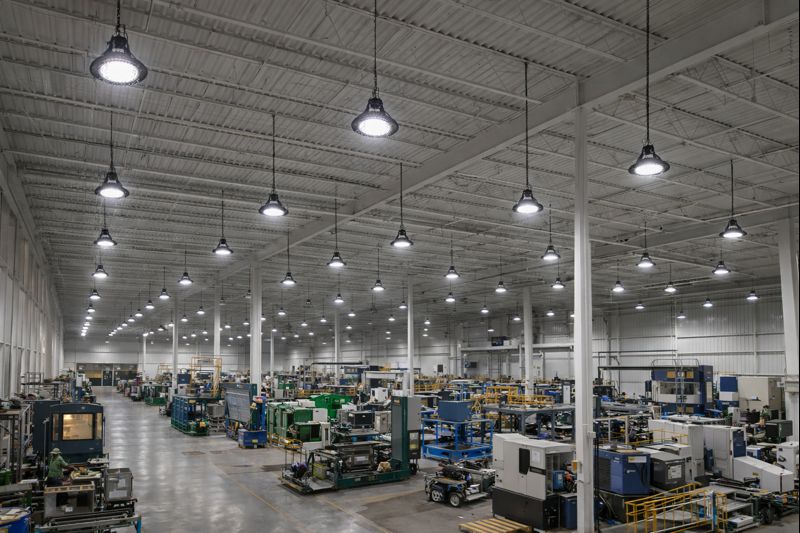
Choosing the right LED high bay light for a factory or warehouse is not simply about selecting the highest wattage available. The correct lighting solution depends on several factors, including ceiling height, required illumination, beam angle, lumen output, spacing, operating environment, and the type of work being carried out.
A properly planned high-bay lighting system can provide more uniform illumination, reduce dark areas, and improve the usability of large industrial spaces. For warehouses and factories, ceiling height should be one of the first considerations because it affects both the required light output and the appropriate beam distribution.
What Is an LED High Bay Light?
An LED high bay light is a high-output lighting fixture designed for spaces with relatively high ceilings. It is commonly used in factories, warehouses, manufacturing facilities, workshops, logistics hub & P and other large indoor spaces.
Unlike ordinary ceiling lights, high bay fixtures are designed to deliver useful illumination from greater mounting heights.
For a factory or warehouse, the objective is not simply to make the ceiling brighter. The light needs to reach the working plane effectively and provide reasonably uniform illumination across the floor.
Why High Bay Lighting Is Important in Factories and Warehouses
Large industrial buildings often have high ceilings, large floor areas and different working zones. A poorly selected lighting system can create:
- Dark areas between fixtures
- Excessive brightness directly below fixtures
- Shadows around machinery and storage racks
- Poor visibility in work areas
- Unnecessary energy consumption
- Uneven illumination across the floor
Good lighting design considers the task being performed, mounting height, fixture output, beam angle and fixture spacing rather than relying on wattage alone.
Start With the Ceiling or Mounting Height
The first question to ask is:
How high will the lights actually be mounted?
High bay lighting is generally associated with higher mounting heights, and the required output and optical distribution change as the mounting height increases.
For example, a warehouse with a 6-metre ceiling will have different lighting requirements from a factory with a 12-metre mounting height.
As a general starting point:
| Mounting Height | Typical Consideration |
|---|---|
| 6–8 m | Medium-to-wide beam and moderate output |
| 8–10 m | Higher output with controlled beam distribution |
| 10–12 m | Higher lumen output and more focused optics |
| 12 m+ | Detailed lighting design becomes increasingly important |
These are starting points, not fixed rules. Final wattage and fixture quantity should be determined from the required illumination level, layout and photometric data.
Understand Lumens Instead of Looking Only at Watts
Wattage tells you how much electrical power a fixture consumes. Lumens tell you how much visible light it produces.
This means a 200W fixture is not automatically better than a 150W fixture.
Two products with the same wattage can produce significantly different light output depending on their LED efficiency and optical design.
When comparing high bay lights, look at:
- Wattage
- Total lumens
- Lumens per watt (lm/W)
- Beam angle
- Color temperature
- CRI
- Operating conditions
For example, if a high bay produces 150 lm/W, a 150W model would theoretically provide around 22,500 lumens before accounting for system-level factors.
The important point is to compare useful light output for the application, rather than selecting the largest wattage.
Choose the Correct Beam Angle
Beam angle is another important specification that is sometimes overlooked.
A wider beam spreads light over a larger area, while a narrower beam concentrates light more strongly.
As mounting height increases, a more controlled beam may be appropriate because the light has a greater distance to travel before reaching the working surface.
A simplified guide is:
| Beam Angle | General Use |
|---|---|
| 120° | Lower ceilings and wider open areas |
| 90° | General warehouse and industrial applications |
| 60°–90° | Higher ceilings and more controlled distribution |
| 60° or narrower | Tall spaces and applications requiring concentrated illumination |
However, beam angle should always be considered together with mounting height, fixture spacing, floor layout and required lux level.
Consider Fixture Spacing
Even a high-quality LED high bay will not perform properly if the fixtures are positioned incorrectly.
If fixtures are installed too far apart, dark areas can appear between them. If they are installed too close together, the installation may use more fixtures than necessary.
The correct spacing depends on:
- Mounting height
- Beam angle
- Lumen output
- Room dimensions
- Rack arrangement
- Reflective surfaces
- Required illumination level
For warehouses with racks and aisles, the lighting layout may need to consider vertical illumination on rack faces, not only light reaching the floor.
Consider the Type of Industrial Space
Not every factory or warehouse has the same lighting requirement.
Manufacturing Areas
Manufacturing areas may require consistent illumination around machinery, production lines and workstations. Areas involving detailed work may require higher illumination than general circulation areas.
Warehouses
Warehouses often have storage racks, aisles and loading areas. Fixture positioning and beam distribution become particularly important to avoid shadows and dark aisles.
Logistics & Distribution Centers
Large logistics spaces may require a combination of general floor illumination and higher illumination in picking, packing and dispatch areas.
Inspection & Quality-Control Areas
Inspection areas can require significantly higher illumination than general storage areas. In such locations, high bay lighting may need to be supplemented with task lighting.
This is why there is no single wattage that is correct for every factory or warehouse.
Pay Attention to Heat Management
Industrial lighting fixtures can operate for long periods, so thermal management is important.
A high-quality industrial LED fixture should have a suitable heat-dissipation design that helps manage the temperature of the LED and driver components.
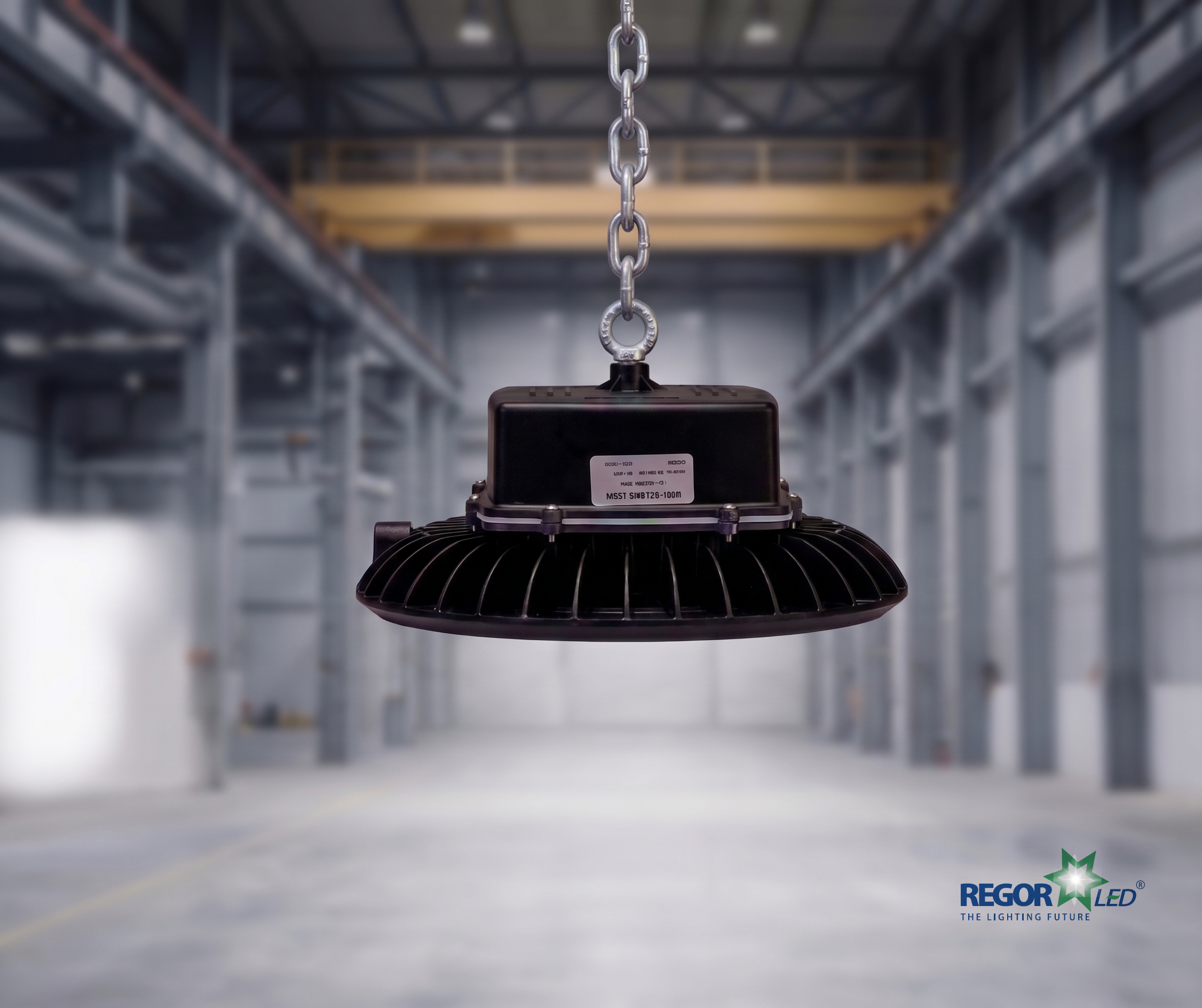
For example, the UFO High Bay Light offered by Electrohaat uses a high-pressure aluminum die-cast body designed for effective heat dissipation.
This type of construction is particularly useful in high-output LED fixtures where thermal performance contributes to long-term reliability.
Choose the Right Color Temperature or CCT
Color temperature affects how the illuminated space looks and how easily people can distinguish objects and details.
Common LED options include:
- 3000K — warmer appearance
- 4000K — neutral white appearance
- 6500K — cooler daylight-style appearance
For many industrial and commercial environments, a neutral or cooler white appearance is preferred, but the final choice should consider the type of work and the visual environment.
Check the Construction and Protection
Before selecting an LED high bay for an industrial environment, check the product construction and protection specifications.
Important factors include:
- Housing material
- Heat-sink design
- Lens material
- IP rating
- Driver quality
- Surge protection
- Operating temperature
- Warranty
- Expected LED life
The requirements can be very different between a clean warehouse and an environment exposed to dust, moisture, oil mist or other contaminants.
Don’t Ignore the Driver
The LED chips are only one part of a high bay lighting system.
The driver also plays an important role in:
- Electrical efficiency
- Power factor
- Protection
- Long-term operation
- Compatibility with the input supply
When comparing products, review the driver’s specifications rather than evaluating the fixture only from its external appearance.
How Many High Bay Lights Do You Need?
The number of fixtures cannot be accurately determined from floor area alone.
A proper lighting calculation considers factors such as:
Number of fixtures = Required illumination × Area ÷ Effective light output
In practice, additional factors such as utilization, maintenance and room characteristics also need to be considered.
For larger factories and warehouses, a photometric lighting layout is preferable to simply estimating the number of lights from wattage.
This is particularly important when the space has high ceilings, racks, machinery or areas with different lighting requirements.
Common Mistakes When Choosing High Bay Lights
❌ Choosing Only by Wattage
A higher wattage does not automatically mean better lighting.
❌ Ignoring Ceiling Height
The same fixture can perform very differently at different mounting heights.
❌ Choosing the Wrong Beam Angle
A beam that is too wide or too narrow can create uneven illumination.
❌ Ignoring Heat Dissipation
Industrial fixtures may operate for long periods, making thermal design important.
❌ Using the Same Lighting Level Everywhere
Storage, production, packing and inspection areas may have different visual requirements.
❌ Installing Without a Lighting Layout
For large industrial spaces, fixture placement should be planned rather than estimated.
❌Buying purely on price per watt
Lower-grade LEDs degrade quickly (lumen depreciation) and fail under high ambient heat.
Why UFO High Bay Lights Are Popular for Industrial Applications
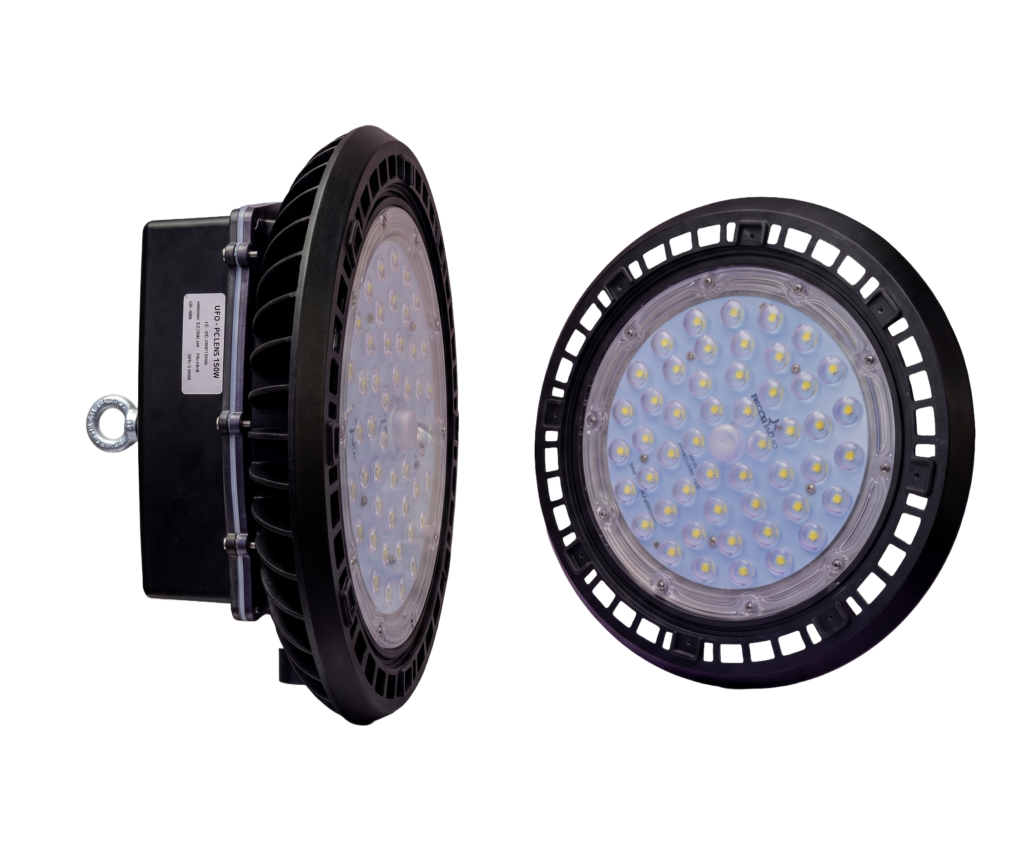
UFO-style high bay lights have a compact circular design and are commonly used in warehouses, factories and other high-ceiling spaces.
The UFO High Bay Light available from Electrohaat is offered in 100W, 120W, 150W, 180W and 200W options, with efficiency up to 150 lm/W according to its product specifications.
It features:
- High-pressure aluminum die-cast body
- Effective heat-dissipation design
- 90° PC lens
- Multiple wattage options
- 3000K / 4000K / 6500K options
- CRI 80
- Power factor above 0.9
- Up to 50,000 hours LED life
- 2-year warranty
For the exact specifications of each available variant, refer to the product’s technical data sheet.
Choosing the right LED high bay light for a factory or warehouse requires more than comparing prices and wattages.
Start with the mounting height, understand the required illumination level, compare lumen output and efficiency, select an appropriate beam angle, consider fixture spacing, and then evaluate construction, thermal management, driver quality and protection.
For large industrial projects, a proper lighting calculation or photometric layout can help ensure that the selected fixtures deliver the required illumination uniformly without unnecessary over-lighting.
The right high bay lighting system can provide a better working environment while also helping businesses make more efficient use of their lighting infrastructure.
For Electrohaat, this article should naturally link to the UFO High Bay Light product page as the relevant product rather than using a generic keyword link.
📍 Electrohaat
For product enquiries, technical information and industrial lighting requirements, use your current Electrohaat business contact details on the website.
Website: electrohaat.com
Location: 2, Mahantam Industrial Estate, Kathwada, Ahmedabad, Gujarat
Enquiries: Reach out directly via the Electrohaat contact portal for product datasheets and quotes.